| < 1910 | 1912 > |
1911 Last "Paige-Detroit"
| Model: | 1 | B | C |
| Cylinders: | 3 | 4 | 4 |
| Horsepower SAE: | 25 | 25 | 25 |
| Wheelbase: | 90 | 90 | 104 |
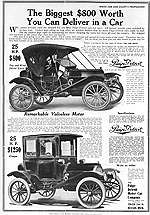
1911 Paige-Detroit 2-cycle models. Motor, October 1910
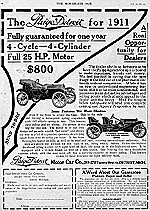
1911 Paige-Detroit 4-cycle models. The Horseless Age, December 21, 1910
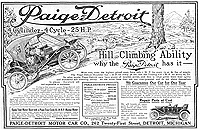
For the 1911 model year Paige-Detroit introduced a conventional four-stroke 25 HP four-cylinder motor. The two-cycle 25 HP three-cylinder engine remained available, and a buyer could choose either. Ads described the Paige-Detroit as a snappy "big little" car that was easy to crank and that required no chauffeur. The company claimed its spring suspension permitted passengers to ride easily over rutted roads, unlike other cars that were inclined to rock and tip, "much to the discomfort of the occupants". Despite the company's belief in the efficiency and future of the two-cycle engine, the emphasis was clearly on the four-cycle version. At some point during the 1911 model run the two-cycle motor was phased out.
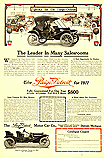
The basic Challenger roadster remained $800 with either motor. Top and windshield were $75 extra. The 90-inch chassis retained the sliding gear transmission with two forward speeds and reverse. A new coupe was available for $1250.
Paige-Detroit developed a longer 104-inch wheelbase chassis for a new $900 open-sided touring car, which came with detachable rear seats so that it could "be used for depot or marketing". A buyer could select a torpedo-type touring car (with side doors) for $975. The longer chassis had a transmission with three forward speeds and reverse.
All cars were fully guaranteed for one year from the date of purchase. Tires and any accessories, however, were covered by guarantees issued by their makers. If a buyer experienced any trouble with any part of the car, it had to be returned to the factory for inspection, freight prepaid, to secure a replacement free from charge. This, no doubt, was a time-consuming process, but perhaps in those days it was just the acceptable way.
The company adopted a policy, unique among manufacturers, of supplying any repair part at cost. Paige-Detroit claimed it did not seek to make a profit on parts sold to repair its cars. "We are satisfied with one profit and don't want two. We do want satisfied owners." Sales jumped to nearly 3,000 cars.
|
|
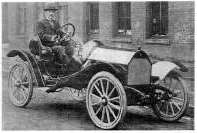 |
| 1911 Paige-Detroit 4-cycle models. Saturday Evening Post, March 4, 1911 | The Leader in Many Salesrooms (Internet image, uncredited) | A 1911 Challenger with Japanese distributor at the wheel. The Horseless Age, April 12, 1911 |
Elsewhere in 1911:
- Charles Kettering develops the electrical self-starter, based on a cash register motor, and sells 8,000 to Cadillac.
- Edward Hines promotes painted center lines on highways to safely separate traffic.
- Louis Chevrolet drives a Buick in the Indianapolis 500.
- Walter P. Chrysler leaves the American Locomotive Works to work for Charles W. Nash at Buick.
| < 1910 | 1912 > |