| < 1922 | 1924 > |
1923
Last Daytona Speedster & Last Paige Truck
| Nameplate: | Paige | Paige | Jewett |
| Model: | 6-66 | 6-70 | 18-22 |
| Cylinders: | 6 | 6 | 6 |
| Horsepower SAE: | 70 | 70 | 50 |
| Wheelbase: | 131 | 131 | 112 |
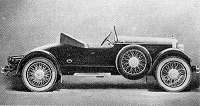
1923 6-66 Daytona (E. E. Husting from "American Vintage Cars" by Charles Betts)
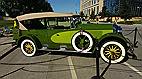
1923 Paige Phaeton (John Quam collection)
The company discontinued the previous year's smaller 6-44 series of Paige autos when 1923 models were announced, because of the popularity of the Jewett. The Company applied the Paige name to the new big six, the 6-70, a line of seven models with prices ranging from $2,450 for a four-passenger phaeton up to $3,435 for a seven-passenger limousine. Next, in the spring the five year-old Paige truck line was phased out to make room for Jewett production. Last, by summer the company announced the building of a new Jewett plant to be ready at the beginning of 1924.
This was the last year that Paige offered the Daytona speedster that had created such excitement when it was introduced in 1921. Sales literature called it an edition de luxe
of the previous year's model. Six wire wheels (a spare at each side) were standard. This was the car,
ad copy claimed, for the busy man who . . . cannot wait for trains
and for those who like to class motoring as a sport.
Paige also dropped the practice of naming open cars, except for the Daytona roadster. Paige touring cars
became phaetons
.
All the 6-70 models came fully equipped, including double-bar spring bumpers front and rear, a motometer with lock, a folding luggage rack at the rear, dual side-mounted spare tires, a cowl ventilator, an adjustable, opaque green glass sunshade over the top of the windshield, a power tire pump with the hose always connected and ready for instant use, and a tool kit stored in the driver's door. Paige sealed the steel universal joints, which did not have to be serviced for 15,000 miles.
-
Paige 6-66
- Roadster, 3-passenger, Daytona, $2,695
- Paige 6-70
The limousine featured a plate glass partition that could be lowered into the back of the front seat "to convert the car into a companionable sedan" whenever the owner drove. When the car was chauffeur driven, there was a handy speaker phone to provide communication when the partition was up. It included such amenities as: taffeta silk roller shades on the rear windows; a vanity case with inlaid walnut that contained perfume vials, a mirror, and memo pad and pencil; a solid walnut steering wheel; and walnut window moldings in the back - an elegant car for just $3,435.
- Jewett models
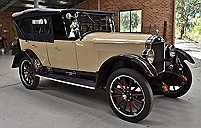
1923 Jewett Touring, an Australian Jewett with right hand drive (Ray Ahern collection)
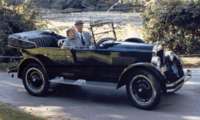
1923 Jewett, Stina and Sten Andersson in Slottskogen Park, Gothenburg, Sweden. (Sten Andersson collection)
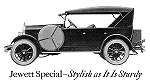
The Jewett lineup consisted initially of four models. All were finished in a Japanese Blue, a special color just for these models. Jewett touring cars remained "touring cars", unlike their big brothers, which had become Paige "phaetons". During February the company announced Special models with added features: side-mounted spare tire, front and rear bumpers, trunk rack and trunk. All three models had a nickel-plated radiator shell and headlamps, double bumpers front and rear, a motometer, automatic windshield cleaner (as a wiper was called then), and an adjustable sun visor. Jewett buyers could drive a car that was nicely appointed but not as expensive as a full-sized Paige.
1923 Jordan Playboy - "Somewhere West of Laramie"
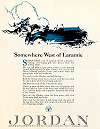
This was the year for one of the most famous automobile ads produced by a Paige-Detroit competitor: Ned Jordan's Somewhere West of Laramie ad for his Jordan Playboy. Ad copy for Jordan models was notable in wanting to excite the reader, rather than appealing to his intellect.
|
| Somewhere West of Laramie, Saturday Evening Post, June 23, 1923 |
In this ad there is no list of the Jordan Playboy's mechanical features. Instead, the ad claims that it's sassy, it's brawny, it's action! it's a cross between the wild and the tame, yet the Playboy is graceful, with hints of laughter and old loves. Who wouldn't want to get behind the wheel of such a car!
The following comments from Edward S. (Ned) Jordan were found in Tim Howley's column in Old Cars newspaper, January 1973:
When I wrote that copy, I was a week late for the Post deadline. On the Overland Limited, roaring over the Wyoming Highlands, bound for San Francisco, we passed some station in Wyoming, too late to catch the sign. Just then the train slowed down. Outside was a horse acting as if he were having his first look at the Union Pacific Iron Horse. Ahh, the girl on that rarin' cayuse! Her hair was flying in the wind, and at every leap that broncho looked as if he might soar off into the wild blue yonder.
"Where are we now" I inquired of my companion, just to make conversation.
"Oh, somewhere west of Laramie," he yawned.
I took an envelope from my pocket, wrote down the phrase, and rambled on. . . .
|
|
|
|
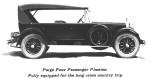
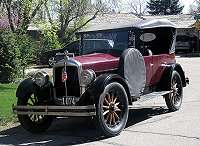
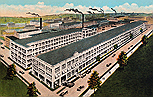
| 1923 Paige Four Passenger Phaeton | 1923 Jewett Special Touring (Joe Benetka collection) | Paige Factory Post Card (collected on the Internet) | 1923 Jewett Special Touring, The American Magazine, 1923 |
|
|
|
|
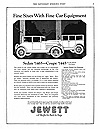
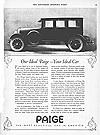
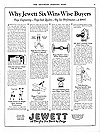
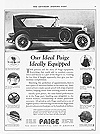
| Fine Sixes with Fine Car Equipment, Saturday Evening Post, December 2, 1922 | Our Ideal Paige - Your Ideal Car, Saturday Evening Post, March 3, 1923 | Why Jewett Six Wins Wise Buyers, Saturday Evening Post, March 17, 1923 | Our Ideal Paige Ideally Equipped, Saturday Evening Post, March 31, 1923 |
|
|
|
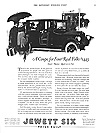
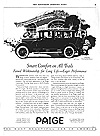
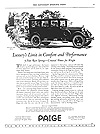
| Jewett: A Coupe for Four Real Folks $1445, Saturday Evening Post, April 14, 1923 | Paige: Smart Comfort on All Trails, Saturday Evening Post, September 15, 1923 | Paige: Luxury's Limit in Comfort and Performance, Saturday Evening Post, October 13, 1923 |
Elsewhere in 1923:
- Firestone introduces the automobile balloon tire.
- Star offers the first factory-built station wagon.
- Oakland uses Duco nitrocellulose lacquer, produced by DuPont under the Duco tradename.
| < 1922 | 1924 > |